Most practices respond to flat organic traffic the same way: publish more. More blog posts, more condition pages, more location pages. For a few months the page count climbs and the traffic line barely moves.
The volume of content was rarely the problem. When I look at a medical website, I am not counting pages. I am checking whether the site can prove four things a search engine can read without guessing: who wrote it, how it was made, which organization stands behind it, and whether anyone else agrees. Most medical sites prove none of them. The reason is usually structural. The website does not mirror how the practice is actually organized.
Google already published the checklist
None of this is a guess about a secret algorithm. Google’s own guidance on creating helpful, reliable, people-first content asks site owners to evaluate their content by “Who, How, and Why.” It encourages “accurate authorship information, such as bylines,” and says that of the qualities in E-E-A-T (experience, expertise, authoritativeness, trust), “trust is most important.”
Two more lines from the same page matter for healthcare. E-E-A-T “isn’t a specific ranking factor,” so there is no single setting to switch on. And health topics fall under what Google calls Your Money or Your Life, where content “must be highly accurate and consistent with established expert consensus.” A medical website is held to the higher bar by default.
So the question is not what Google wants. Google has said it. The question is whether your site answers in a form a machine can verify, or only in paragraphs a human has to read and trust.
Proof 1: who wrote it
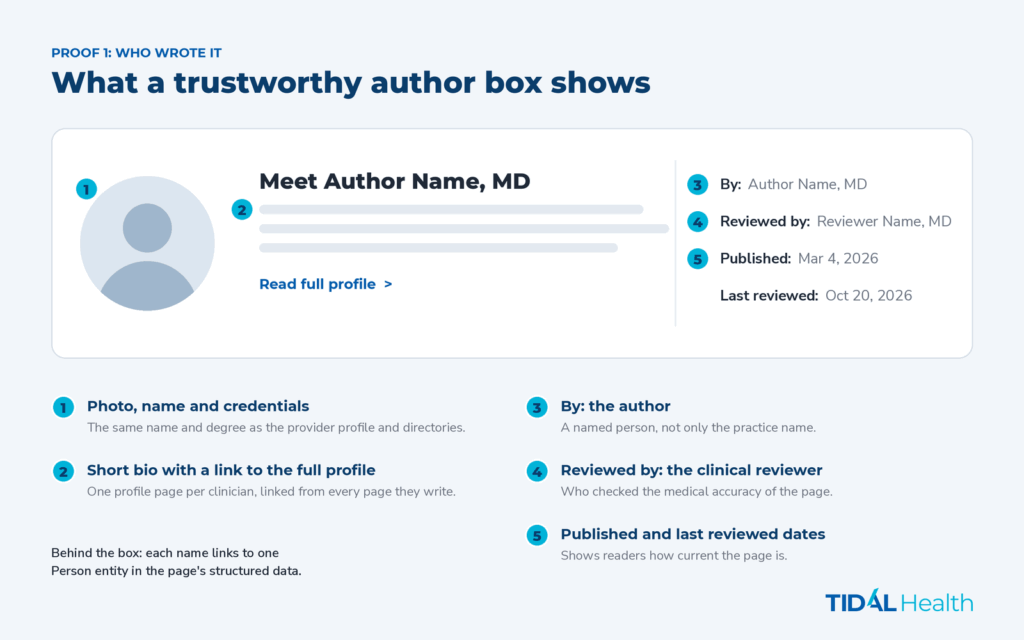
A real byline on every clinical page, with credentials a reader can check. The author’s name, degree and board certification should match what appears on their provider profile, their hospital affiliation and the public directories that list them.
On the technical side, the author should exist once, as a single Person entity, and every page they wrote or reviewed should point to that same entity. A byline that is plain text on one page, a different spelling on another and missing from a third gives search systems three weak signals instead of one strong one.
Proof 2: how it was made
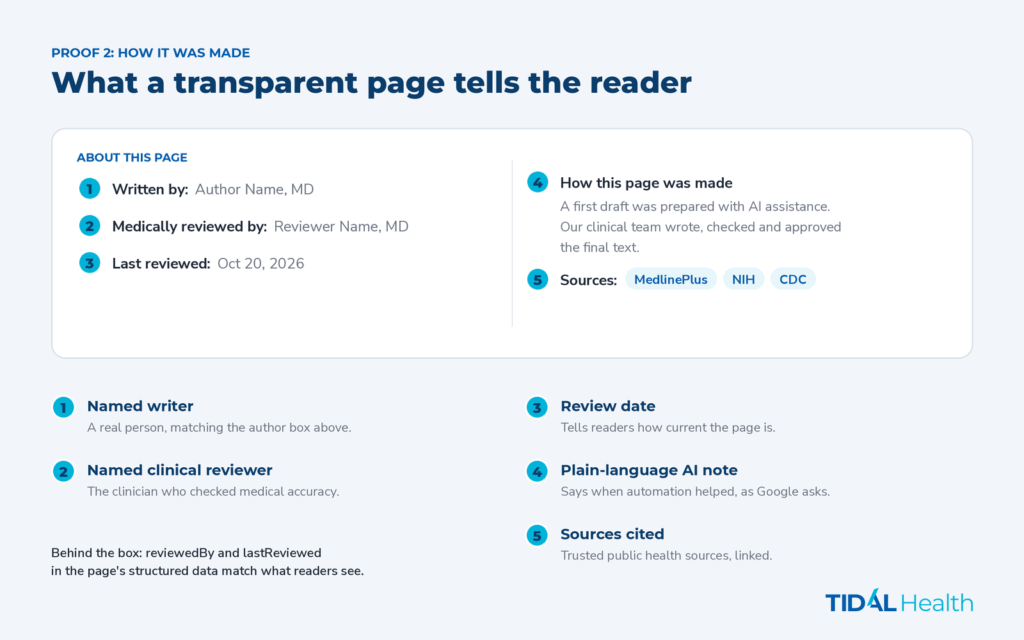
This is the proof most practices skip. Google asks whether it is clear how a piece of content was produced, and specifically whether the use of automation, “including AI-generation,” is “self-evident to visitors through disclosures or in other ways.”
For a medical page, “how it was made” usually means three visible facts: who wrote it, which clinician reviewed it, and when it was last reviewed. If AI helped draft the page, say so in plain language. A named reviewer and a review date may help patients and search systems judge how current and accurate the page is. Hiding the process does not make the content look more expert. It makes it harder to trust.
Proof 3: which organization stands behind it
This is where most medical websites break, and where I spend most of my time.
My view is simple. The website is the central source of truth for the practice, and its structure should replicate the business. A patient who lands on a specialty page should find the doctors who practice that specialty, the locations where they see patients and the department it belongs to, on that page, without hunting through menus. We call this Entity Promotion (CMS): information architecture that models departments, specialties, insurance and care delivery the way the practice actually runs.
When the site is built that way, structured data has something true to describe. When it is not, structured data becomes a sticker.
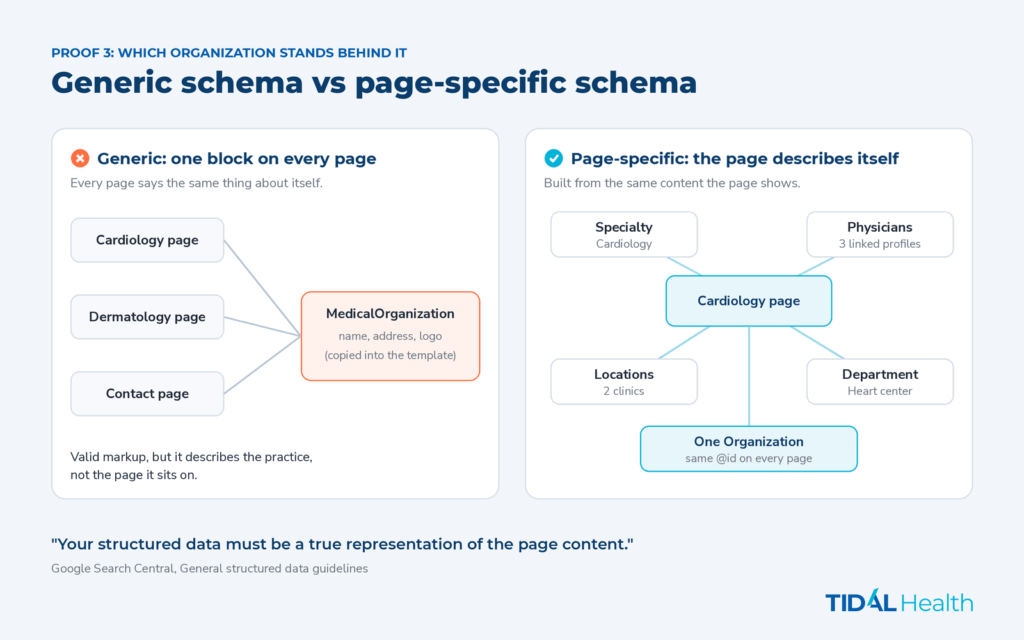
Here is the pattern we see in audits. A site carries one generic block of MedicalOrganization markup, the same name, address and logo, copied into the template of every page. The cardiology page, the dermatology page and the contact page all tell search engines the same thing: this is a medical organization. None of them say what the page itself is about.
The alternative is page-specific schema. The cardiology page describes that page: the specialty, the physicians who practice it, the clinics where they see patients and the department that owns it, all linked back to one organization. Each fact in the markup also appears in the visible content, because the markup is generated from the same structured content the page displays. That is the core of Schema.org Optimization (Healthcare): medical schema modeling for providers, services and outcomes, page by page.
This is not only our preference. Google’s general structured data guidelines say “your structured data must be a true representation of the page content” and “don’t mark up content that is not visible to readers of the page.” A generic block pasted everywhere does not break those rules, but it does not describe anything either. Page-specific markup that matches the page is what the guidelines describe.
One more habit belongs here. Schema breaks quietly when a theme, template or plugin updates. Checking it once at launch is not enough.
Proof 4: whether third parties agree
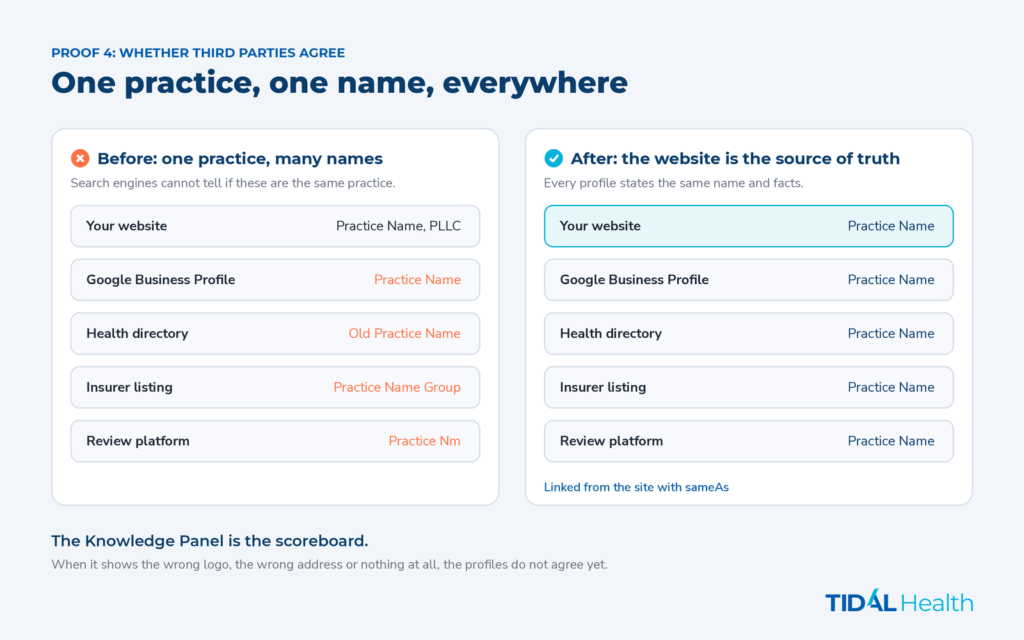
The last proof lives mostly off your site. Your Google Business Profile, the major health directories, insurer listings, hospital affiliation pages and review platforms all describe your practice. Search engines compare them with what your site says.
Google’s documentation on Organization structured data says the markup can help Google “disambiguate your organization in search results,” and defines the sameAs property as “the URL of a page on another website with additional information about your organization.” In practice, sameAs is how your site points to the profiles that should agree with it.
The common failure is three versions of the practice’s own name: the legal name on the site, a shortened name on the Business Profile and an old name on a directory nobody has updated since a merger. Knowledge Panel Optimization is the work of aligning brand facts, corroboration and schema so the panel stabilizes. The Knowledge Panel is also the most visible scoreboard for this proof. When it shows the wrong logo, the wrong address or nothing at all, the third parties do not agree yet.
Why AI search raises the stakes
AI answers in search summarize many pages and cite a few. A site whose facts are structured, consistent and corroborated is simply easier to cite than one that makes a search system reconcile three versions of the same doctor.
Measurement is also catching up. In June 2026, Google introduced Generative AI performance reports in Search Console, which give site owners a first-party view of how their pages appear in Google’s AI search features. That turns AI visibility from a guess into a number a practice can track month over month, alongside rankings and clicks.
How we hold the bar
Tidal Health Group is a marketing agency with its own development team, and that changes what “done” means on a new website. We check ADA conformance and schema.org coverage before launch, and then we keep measuring both on our internal platform after launch. Day one is the starting line, not the finish.
We also put a number on it. Each client gets a Vital Signs baseline across five signs: Trust, Expertise, Visibility, Proof and Experience, each scored out of 5 and rescored every 90 days in the quarterly review. Two of them track the proofs in this article directly. Expertise looks for named authors, “Medically reviewed by” lines and clinician schema. Proof looks for identity links, such as sameAs, between the site and the profiles that should agree with it. The first baseline comes from public data only, so it measures a practice’s digital footprint, not the quality of its care.
The same structure that makes a specialty page useful to a patient makes it legible to a search engine. We build the relationships between specialties, providers, locations and departments into the CMS, and the schema is generated from those relationships instead of being pasted into templates. When a provider joins or a location changes, the content and the markup change together.
What to do first: a 20-minute self-check
Open three pages on your site: a specialty page, a provider profile and a location page. Answer five questions with yes or no.
- Does every clinical page name its author and a clinical reviewer, with a review date?
- On the specialty page, can a patient reach that specialty’s doctors and locations in one click?
- Does the page’s structured data describe that page, or the whole practice?
- Is the practice name identical on the site, the Google Business Profile and your top three directories?
- Does anyone check structured data after every theme, template or plugin update?
Every “no” is one of the four proofs your site is not making yet. Start with question 2. If the site does not mirror the practice, the other fixes have nothing solid to attach to.
See where your site stands
An AuthorityInsite Audit shows where each of the four proofs breaks on your site, from bylines and page-level schema to the third-party profiles that disagree with you, and turns it into a prioritized roadmap. If you already know the structure needs work, our healthcare SEO team can walk you through what a rebuild of your specialty pages would involve.