LMH Health, formerly known as Lawrence Memorial Hospital, is a regional healthcare provider based in Kansas. Positioned in a care desert between two much larger systems, LMH plays a vital role for its community, offering both local hospital services and access to advanced specialty care through partnerships.
Yet online, the brand was telling a very different story. Even something as simple as their name - LMH Health or Lawrence Memorial Hospital - was inconsistent across platforms. Service lines and provider information were scattered - Multi-Location Entity Sync was missing - and directories were incomplete, and their website lacked the structure (Entity Promotion (CMS)) and proof (Social Proof Widgets) to back up the quality of care they delivered every day.
Patients, and even search engines, struggled to understand who LMH was, what they offered, and how to access their services.
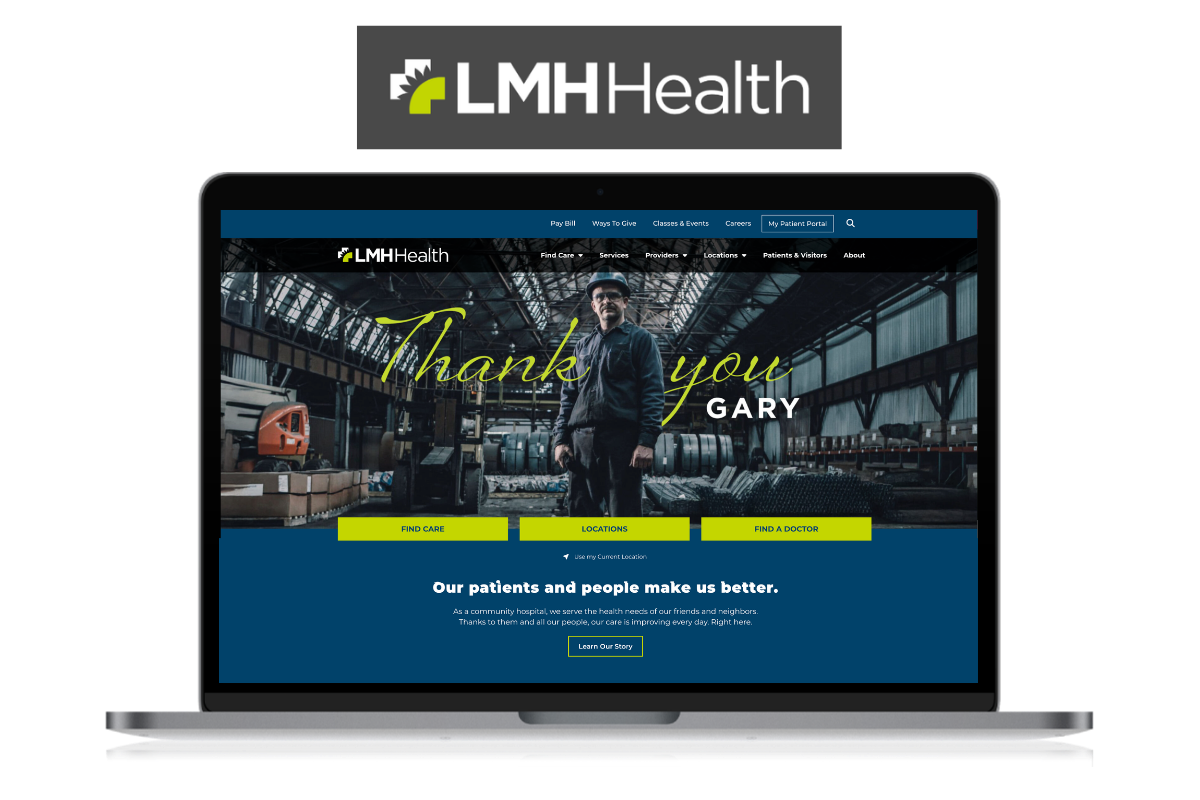
Leadership at LMH was acutely aware that they were behind the times. Best practices in healthcare marketing and digital infrastructure had moved forward quickly, and LMH wanted not just to catch up, but to leapfrog into a more modern, competitive position.
The problems ran deeper than a few missing updates. Their identity was muddled, with confusion around their relationship to the University of Kansas. Reviews were inconsistent, often negative, and rarely acknowledged - missing on-site Social Proof Widgets to surface credibility. Service lines lacked clarity. Claims of advanced care and partnerships with top providers were made but not substantiated with visible evidence online (Scientific Credentials Signaling). Even the basics - site speed, accessibility standards, search console compliance - had been overlooked.
The net effect was "entity ambiguity," a gap Multi-Location Entity Sync is designed to solve. For patients searching online, it was unclear where LMH began and ended, who their providers were, or what made them different from larger regional competitors.
Tidal Health Group began with an AuthorityInsite Audit to benchmark LMH across visibility, trust, proof, expertise, and experience. The analysis revealed a significant gap between the organization's offline reputation and its digital authority. In person, LMH had the providers, partnerships, and clinical depth to command trust. Online, those signals were faint or missing altogether.
From there, the work focused on laying a foundation. The team collaborated with a brand partner to run a listening tour and craft a cohesive brand narrative - Translate Offline Authority Online - that would bring unity to their messaging and web presence. Technical partners were introduced to modernize systems, including a sophisticated self-scheduling tool implemented as Appointment Booking Integrations directly into LMH's electronic health records. And the website itself was assessed against the basics - page speed, ADA compliance, structured data integrity - via a Technology & Speed Deep-Dive, with a roadmap to bring those standards up to par.
What emerged was not a new campaign or one-off fix, but a strategy to align identity, technology, and authority so LMH could finally be represented online as the organization it already was offline.
While most of the work is still in progress, the transformation has already begun. For the first time, LMH has a clear understanding of the gap between their physical authority and their digital presence. They have a new brand narrative in development, modern technology partners preparing to improve scheduling and compliance, and a prioritized roadmap - standardized on a HIPAA-Compliant Event Taxonomy - that addresses both high-level identity issues and basic technical hygiene.
Though patients may not yet see the changes, internally LMH is shifting from an organization defined by inconsistency to one preparing for clarity and competitiveness. The groundwork has been laid for a digital presence that reflects their reputation as a trusted community hospital.
LMH didn't come to Tidal Health Group simply looking for better campaigns. They came seeking alignment - between who they are, what they offer, and how that is experienced online.
By diagnosing their weaknesses with an AuthorityInsite Audit, clarifying their brand identity (Translate Offline Authority Online), and preparing the foundation for new systems and best practices (Appointment Booking Integrations, Technology & Speed Deep-Dive, HIPAA-Compliant Event Taxonomy), LMH has begun the process of closing the gap.
The work is ongoing, but the direction is clear: a move from confusion and inconsistency to a digital presence that finally matches their real-world authority.
Healthcare-exclusive digital marketing agency. We help practices close the gap between their clinical reputation and how they appear online, turning that into consistent, measurable patient growth.