Children's Mercy in Kansas City is one of the nation's largest independent children's hospitals, caring for more than half a million patients each year. Among its most distinguished programs is the Colorectal Center, led by surgeons who are recognized as some of the highest-volume specialists in the country. Clinically, the center stood at the forefront of pediatric colorectal care.
But online, the story didn't come through.
Families searching for help weren't finding them, or if they did, the language used on the website and in campaigns often felt cold, clinical, and distant. For a department treating some of the most sensitive, life-altering conditions in children, that disconnect mattered.
The issue wasn't a lack of expertise. The Colorectal Center had world-class authority, but its digital presence failed to meet families where they were.
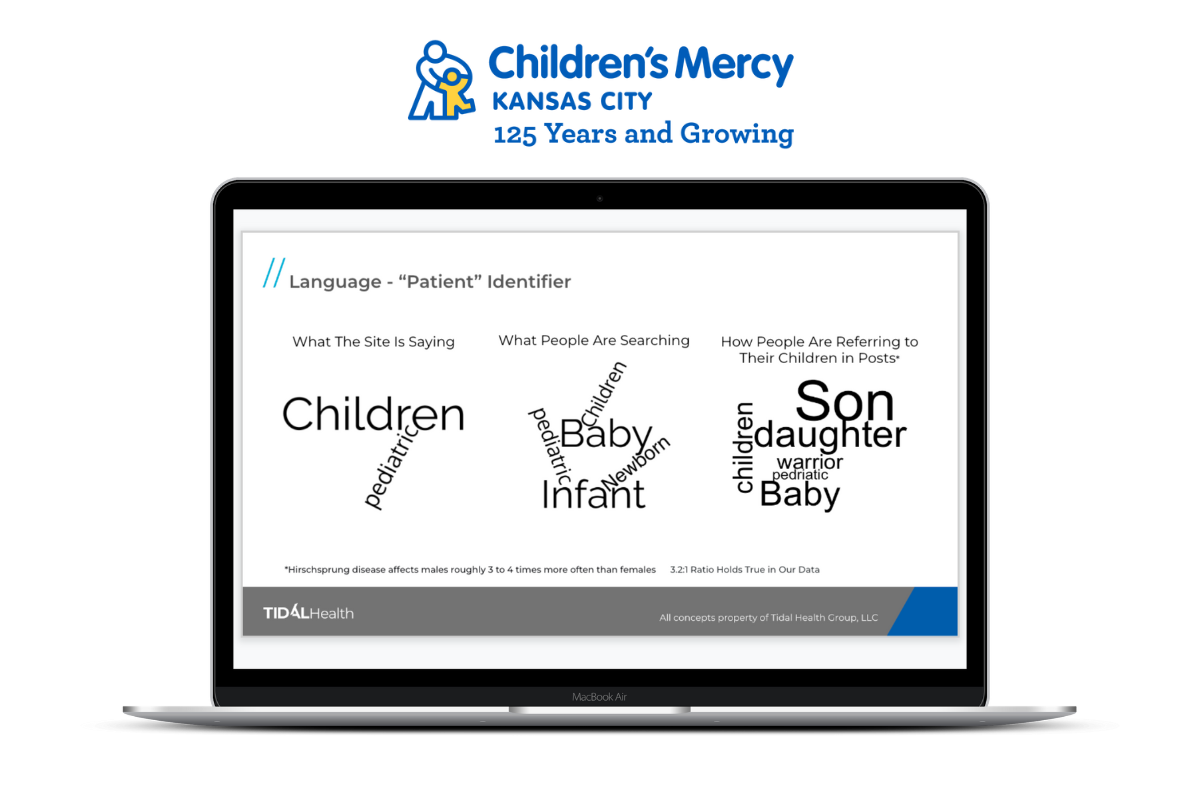
The problem began with language. Internally, everything was described in departmental terms - "pediatric colorectal," "comprehensive care center," "children's surgical services." But parents searching online used much more personal, emotional words: baby, infant, newborn, daughter, even warrior. Families didn't talk about "comprehensive centers." They searched for specific symptoms, conditions, or the type of doctor they hoped could help their child - signals that are mapped and interlinked via Multi-Location Entity Sync.
The site itself added to the confusion. Key details about providers and services were buried in complex structures - work suited to Entity Promotion (CMS). Schema data, which should have helped search engines understand and surface that authority, was either missing or misaligned - addressed in a Technology & Speed Deep-Dive. Even Dr. Rebecca Rentea, one of the most respected surgeons in her field, was nearly invisible online - lacking Scientific Credentials Signaling across her profile and content.
The result was a painful gap. Thousands of parents were searching for help every month, but the language mismatch and poor structure meant Children's Mercy wasn't connecting with them. Campaigns suffered with high costs and low conversions. And most importantly, families in need weren't finding the experts who could help them.
Tidal Health Group was brought in to perform an AuthorityInsite Audit, an in-depth audit of the Colorectal Center's digital presence.
The team started with deep research. On the quantitative side, they analyzed search behavior, uncovering more than 27,000 high-intent keywords that parents were actively using but that the hospital wasn't addressing. On the qualitative side, they studied parent forums, social groups, and community conversations, building a map of the real words families used when talking about their children's conditions.
Then came the technical review. Every layer of the site was examined, from copy and navigation to schema and structured data, to understand why the center's authority wasn't being recognized online. The audit made clear where language needed to shift (Translate Offline Authority Online), where provider expertise needed to be surfaced (Scientific Credentials Signaling), and how the site could better connect families to the right information.
The audit revealed both the size of the opportunity and the path forward. By realigning language to match how parents actually search, Children's Mercy could capture tens of thousands of additional high-intent queries. By restructuring pages with Entity Promotion (CMS) and surfacing provider expertise via Scientific Credentials Signaling, they could present themselves not just as a department, but as the nation-leading authority they already were.
The recommendations became the foundation for a communication overhaul: warmer, more empathetic language; campaigns that spoke in the words parents actually used; a clearer, more authoritative site structure (Entity Promotion (CMS)); and on-page proof via Social Proof Widgets. The result was not just a set of fixes, but a roadmap for how to bring clinical excellence and digital authority into alignment.
Children's Mercy didn't need to create authority. They already had it. What they needed was a way to make that authority visible, relatable, and accessible to the families searching for care.
By conducting a rigorous AuthorityInsite Audit, then applying Translate Offline Authority Online and Entity Promotion (CMS) patterns, Tidal Health Group helped the Colorectal Center understand the gap between how they spoke and how families searched. And in closing that gap, they gave Children's Mercy the tools to reach the right parents, with the right message, at the moment they needed it most.
Healthcare-exclusive digital marketing agency. We help practices close the gap between their clinical reputation and how they appear online, turning that into consistent, measurable patient growth.