Advantia Health is a women's health platform that grew rapidly across the Mid-Atlantic and Midwest through a series of acquisitions. Backed by private equity, they brought together more than a dozen practices covering OB-GYN, maternal-fetal medicine, primary care, and more.
While the growth strategy was working, the digital foundation underneath it was cracking. Each practice had its own website, ad account, and tracking setup. The new umbrella brand, Advantia Health, existed in name but not yet in execution. To keep scaling, they needed to unify their digital presence, simplify operations, and still preserve the reputation of each local practice.
By the time Advantia engaged Tidal Health Group, they were operating 13 to 14 separate websites. Patients were left confused, unable to navigate between practices or find the right provider. Content was duplicated across sites, making it impossible to manage consistently.
On the marketing side, the fragmentation was even more painful. Paid search campaigns were spread across multiple accounts, with budgets diluted and insights unreliable. Cross-Domain Tracking Architecture often broke when patients moved between domains. Leadership lacked Cross-Domain Booking Attribution, making it hard to see which efforts were driving repeat, long-term patients versus wasted spend.
The bigger issue was scalability. Every new acquisition meant another site, another ad account, another tangle of complexity. Advantia needed more than a redesign. They needed a digital operating system.
Tidal Health Group guided Advantia through a transformation that reduced self-imposed complexity and built a platform designed for growth, validated by a Technology & Speed Deep-Dive.
The first step was creating a single source of truth. We worked with Advantia to map every brand, location, provider, and service into a multi-relational database for Multi-Location Entity Sync. This ensured each piece of content, whether a doctor's profile or a service description, existed once and could be reused everywhere. That model became the foundation of the new website ecosystem.
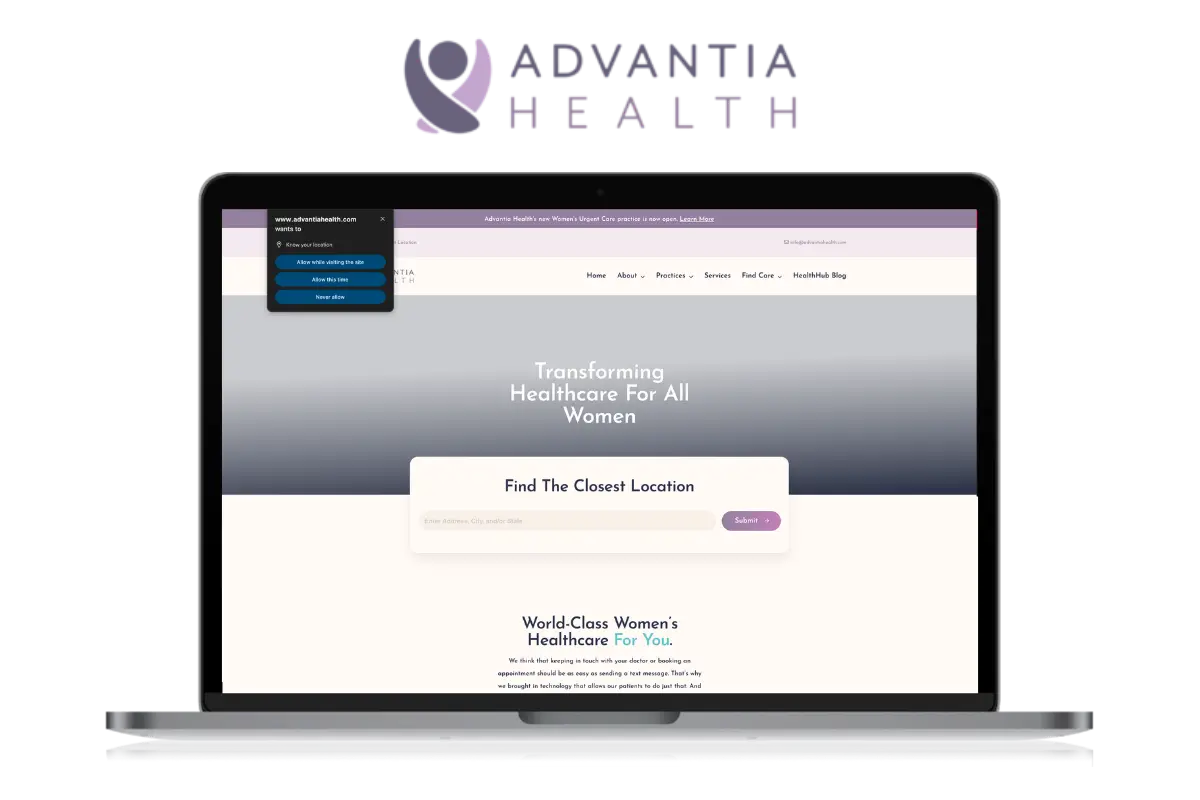
From there, a new central hub, advantiahealth.com, was launched as the authoritative directory of all locations, providers, and brands using our Multi-Location Architecture. This distinction mattered. Many of the locations still operated under their own brands, which Tidal preserved by housing them as subfolders under the primary Advantia domain using our Multi-Location Architecture. This approach maintained each practice's visual and structural identity while standardizing the overall patient experience across the network with components like Social Proof Widgets. A careful redirect strategy made sure years of earned SEO value weren't lost in the process.
Analytics were rebuilt around a HIPAA-Compliant Event Taxonomy to close long-standing data gaps. We introduced cross-domain tracking, cleaned up referral exclusions, and implemented a Conversion Audit framework that measured what really mattered, with Appointment Booking Integrations capturing booked appointments, calls, and high-value service requests.
Healthcare PPC was consolidated to match the new structure. Campaigns were reorganized around geographies and services, making it easier to scale where demand was needed and pull back where practices were already full. Budgets could now be directed strategically, rather than scattered across disconnected accounts.
Finally, the process itself became repeatable. New acquisitions could be onboarded into the system quickly, with a clear playbook for data intake, site mapping (Multi-Location Architecture), analytics (HIPAA-Compliant Event Taxonomy), and campaigns.
The difference was immediate. Domain authority increased (specific figures to be confirmed with partner agency 9Sail). Patients could now find care more easily through a geo-based "Find Care" search powered by Multi-Location Entity Sync. Editors no longer had to maintain 14 versions of the same content. Campaign efficiency improved so much that in several markets, Advantia had to intentionally scale back budgets to keep patient flow manageable.
Most importantly, Advantia gained control. Instead of struggling with self-imposed complexity, they now had a streamlined system that let them make strategic decisions in real time. The foundation they built not only simplified day-to-day operations, it gave them confidence to continue acquiring new practices at speed.
Advantia's transformation wasn't about launching another website. It was about rethinking their digital infrastructure to match their growth ambitions. By centralizing content, rebuilding analytics, and restructuring paid media, they turned fragmentation into a growth engine.
Tidal Health Group's role was to guide the process, helping Advantia cut through the noise, keep what mattered, and build a platform that will scale with them for years to come.
Healthcare-exclusive digital marketing agency. We help practices close the gap between their clinical reputation and how they appear online, turning that into consistent, measurable patient growth.