For more than half a century, Weil Foot & Ankle Institute has been one of the most trusted names in podiatry. Based in Illinois and steadily expanding across multiple states, the practice built its reputation on clinical excellence, pioneering research, and one of the first accredited fellowships in the specialty. The institute had everything a patient or referring physician could want - deep expertise, a national footprint, and a long history of innovation.
But online, none of that came through. Despite their real-world authority, Weil's digital presence looked almost indistinguishable from any other podiatry group. Their growth through acquisitions had only made things more fragmented - work that required Multi-Location Entity Sync to unify websites, profiles, and campaigns across platforms. The gap between their offline reputation and their online visibility had become too wide to ignore.
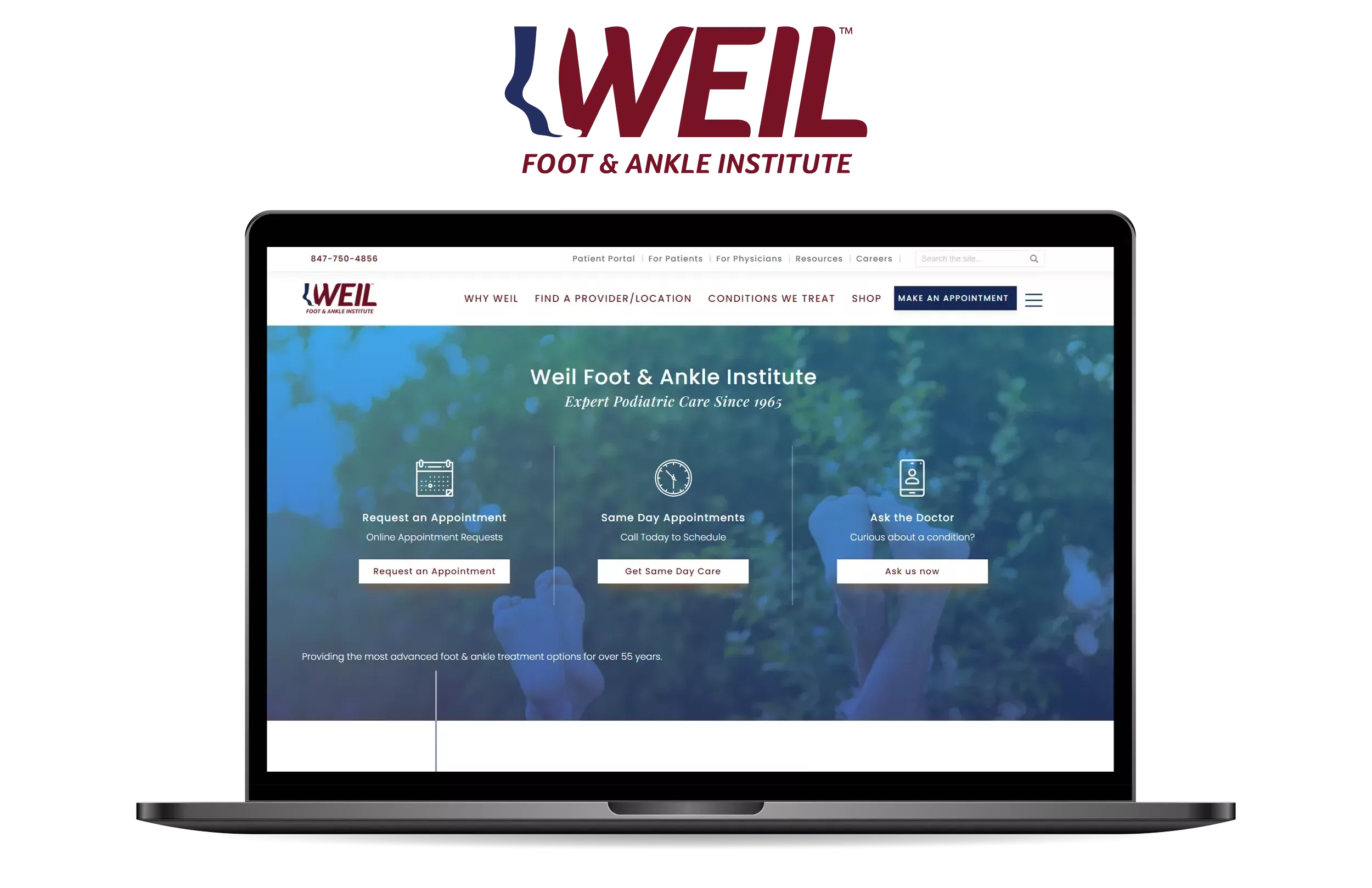
By 2021, Weil was acquiring practices at a rapid clip and needed a digital system that could scale with them. Instead, they had a patchwork of sites and inconsistent branding that confused patients and diluted search visibility. Their marketing spend was significant, but leadership had little clarity into what was working or where dollars were being wasted - until a HIPAA-Compliant Event Taxonomy established a consistent measurement baseline.
Reputation building was still a manual process, dependent on staff nudges, with no system to generate reviews at scale or surface them via Social Proof Widgets.
Perhaps most striking was that their unique story - fellowship programs, role in shaping the field, decades of research - lacked Scientific Credentials Signaling online. A practice that had trained generations of podiatrists and pioneered surgical techniques was showing up digitally like a run-of-the-mill provider. Patients searching for care in Chicago or beyond had no way of understanding the depth of Weil's expertise.
Tidal Health Group began with an AuthorityInsite Audit to diagnose the gap between Weil's offline authority and its online presence. From there, the work focused on building a digital foundation that could both communicate their legacy and support future growth. The website was restructured using Entity Promotion (CMS) to make departments, providers, and services clear and interconnected, creating an experience that patients and search engines alike could navigate with ease.
Healthcare PPC campaigns were restructured to tie spend directly to patient acquisition - replacing a scattershot approach with Cross-Domain Booking Attribution that aligned budget with measurable outcomes. On the reputation front, manual processes gave way to technology-driven systems, ensuring a steady flow of reviews that reinforced the trust patients already felt in Weil - and surfaced on-site via Social Proof Widgets. Scheduling visibility improved as Appointment Booking Integrations fed booking data into analytics governed by a HIPAA-Compliant Event Taxonomy.
Every step of the process came back to a central goal: making sure that Weil's authority in the real world was just as visible in the digital one.
The transformation gave Weil Foot & Ankle a digital presence that finally matched its real-world reputation. Patients searching for podiatric care now encounter a brand that looks as authoritative online as it has been in practice for decades. Reviews arrive consistently, campaigns run with measurable efficiency, and new acquisitions can be integrated seamlessly into a unified brand framework through Multi-Location Entity Sync.
Most importantly, the story of Weil's legacy - the pioneering surgeons, the accredited fellowship, the decades of research and training - is now discoverable in the places where patients begin their search for care, supported by Scientific Credentials Signaling. What once was hidden is now a clear point of differentiation, helping Weil grow both its footprint and its reputation in a competitive market.
Weil didn't need to invent authority. They had spent generations building it. What they needed was a way to translate that legacy into digital systems that could scale. By aligning their site structure (Entity Promotion (CMS)), campaigns (Healthcare PPC + Cross-Domain Booking Attribution), measurement (HIPAA-Compliant Event Taxonomy), and multi-location operations (Multi-Location Entity Sync), Tidal Health Group bridged the gap between offline excellence and online presence.
The result is a practice that not only leads in the clinic but also sets the standard for how authority in healthcare should be represented online.
Healthcare-exclusive digital marketing agency. We help practices close the gap between their clinical reputation and how they appear online, turning that into consistent, measurable patient growth.